



Real Money, Real Decisions: How BISR Tabuk Students Are Preparing for the Future
Kevin James
Deputy Headteacher, BISR Tabuk
How do you decide whether you can afford a new car? Is it better to save your money or invest it? What happens when an unexpected bill arrives? These are questions we all face as adults, but they are also questions our Year 5 and 6 students have been exploring through our financial education lessons.
Financial education is something I am particularly passionate about. Like many people, much of my own understanding of budgeting, saving and investing developed later in life through experience and independent learning. Looking back, I would have valued more opportunities to develop these skills when I was younger. This has made me passionate about giving our students an early introduction to financial decision-making and the confidence to talk about money openly.
Welcome to the Real World
At the beginning of the project, students are given an income and a set of personal circumstances. From there, they begin building and managing their own budget. They need to consider housing, transport, food, utilities, subscriptions and other lifestyle choices. Importantly, there is rarely one ‘correct’ answer.
As the weeks progress, students can reconsider earlier decisions. Could selling a car and buying a bicycle improve their finances? Is spending money on further education worthwhile if it could increase future earnings? These discussions allow us to explore broader concepts such as choice, risk, responsibility, change and consequence, rather than simply teaching students how to complete a calculation.
Learning That Goes Beyond the Classroom
This links closely to our wider approach to teaching and learning at BISR Tabuk. Julie Stern’s ‘Learning That Transfers’ focuses on helping students connect concepts and recognise patterns so they can apply their knowledge to new and unfamiliar situations. Our financial education project provides students with repeated opportunities to do exactly that.
Each week, circumstances can change. Students may experience an unexpected expense, receive some good financial news or see an investment rise or fall. They must draw upon previous learning, adapt their thinking and decide what to do next.
The project also links to Michael Fullan's work on developing the 6Cs of Deep Learning: character, citizenship, collaboration, communication, creativity and critical thinking. Students explain and defend financial decisions, listen to alternative approaches, solve problems and consider the consequences of their choices.
This also reflects Matthew Savage’s emphasis on knowing our students deeply and using what we notice about their interests, choices and responses to shape meaningful learning experiences. As the project develops, the decisions students make help inform the questions, challenges and opportunities they encounter next.
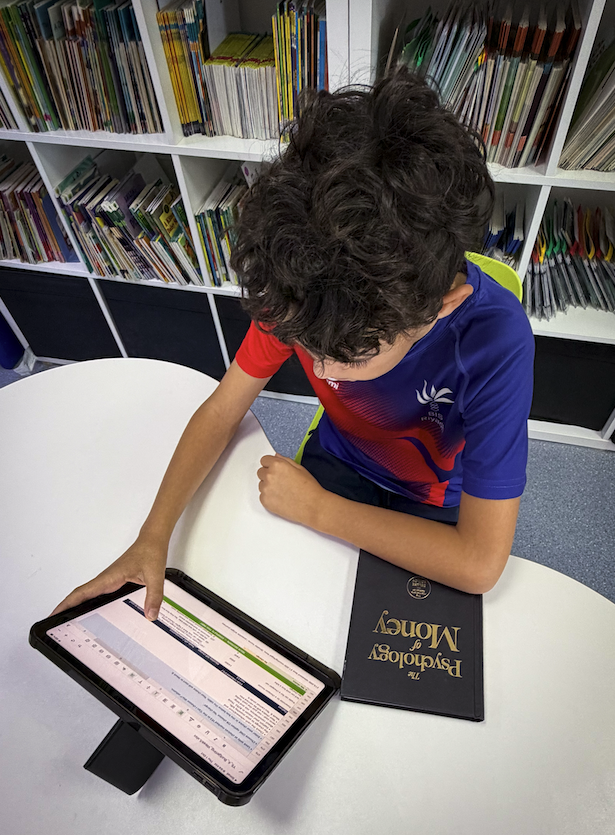
One of the most encouraging examples has come from Thiago (Year 6), whose interest has extended well beyond our lessons. Inspired by the project, he independently bought ‘The Psychology of Money’ by Morgan Housel. He has since referenced ideas from the book during other maths lessons, connecting his independent reading with classroom learning. For me, this is a wonderful example of learning transferring beyond a single lesson: curiosity sparked in the classroom leading to independent learning, which is then brought back into school and applied in new contexts.
Preparing Students for the Future
The project naturally develops mathematical skills including percentages, interest, budgeting and working with spreadsheets, but its purpose extends much further. Students are learning to evaluate risk, distinguish between wants and needs, plan ahead and understand that decisions made today can have consequences later.
We cannot predict exactly what financial decisions our students will face in 10, 20 or 30 years. What we can do is help them develop the concepts, knowledge and transferable skills to approach those decisions with greater confidence.
Ultimately, financial education is not about turning 10-year-olds into financial experts. It is about giving them opportunities to make decisions, make mistakes safely, question their assumptions and learn from the consequences.